Executive insight
How to move AI pilots into production without losing control
Quick answer: Most AI pilots fail to reach production because the pilot proves a technical possibility without proving the operating model. Production requires a named owner, a controlled workflow, risk controls, monitored performance and a value measure that leadership trusts. A pilot can pass a demo and still fail this test. Pilot-to-production work should be treated as an operating decision, not a showcase.
Most AI pilots fail to become useful operating capabilities because the pilot proves a technical possibility without proving the operating model. Production requires a named owner, a controlled workflow, monitored performance, risk controls, user adoption and a value measure that leadership trusts.
Who is this guide for?
This guide is for executives who have pilots, prototypes or informal AI tools inside the organisation and need to decide what should be scaled, repaired, governed or stopped.
What is the production-readiness sequence?
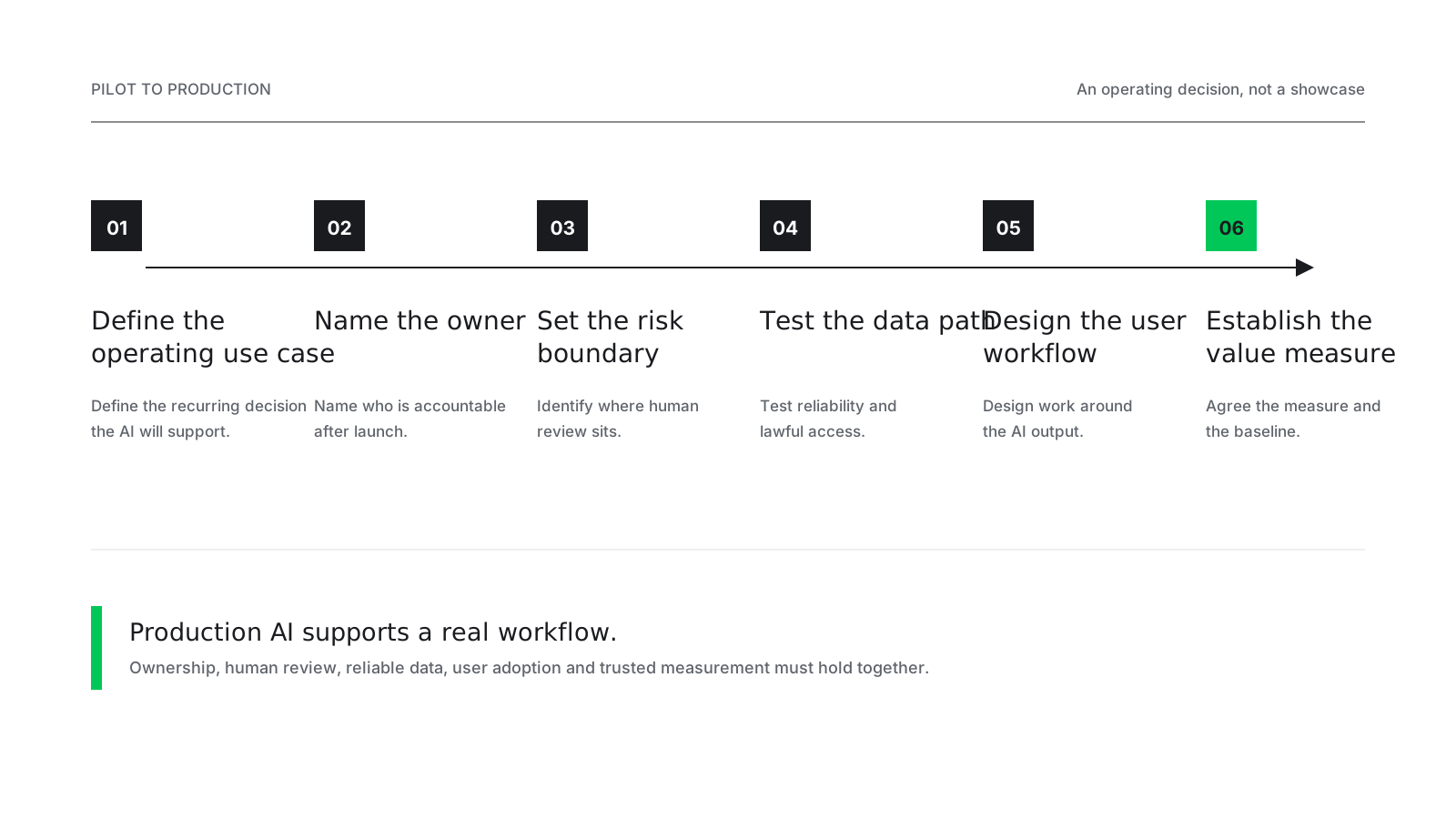
Use this sequence before increasing investment: define the operating use case and the recurring decision the AI will support; name the owner who is accountable after launch; set the risk boundary and identify where human review sits; test the data path for reliability and lawful access; build measurement so leaders can tell whether it is working; plan adoption by identifying what changes for the team using it; and control change through a release process, logs and review cadence. A pilot can pass a demo and still fail this sequence. Leadership should treat pilot-to-production work as an operating decision.
What are the common problems when moving AI pilots to production?
The first problem is unclear ownership: a central innovation team can start a pilot, while production needs an accountable business owner. The second is weak workflow integration: adoption will be fragile if users must leave their normal tools, duplicate work or manually reconcile outputs. The third is unmeasured value: leaders need to know which metric should move and which risks must stay within tolerance. The fourth is late governance: risk review should guide the design before launch, while teams can still change the solution.
Which governance sources help anchor the work?
NIST AI RMF 1.0 separates risk work into Govern, Map, Measure and Manage — a pilot-to-production process can use those functions as decision gates. ISO/IEC 42001:2023 helps organisations define repeatable controls across teams and use cases. The UK government's AI regulation approach is principles-based: safety, transparency, fairness, accountability and redress should appear in the operating design.
What does a good AI production plan include?
A good production plan names the live workflow and affected users; ownership across business, technology, risk and operations; data access and quality constraints; human review and escalation rules; measurement for value, quality, adoption and risk; a release plan with rollback and incident handling; and a review cadence for model, process and policy changes. If the plan cannot name these elements, the organisation is still in pilot mode.
When is Black & Rhine a fit?
Black & Rhine fits leaders who need to decide which AI pilots deserve production investment and which operating controls must come first. A pilot review starts with what exists, what value it could create and what is missing before scale.
Questions leaders ask about production AI
When should an AI pilot be stopped?
Stop or pause a pilot when the business problem is unclear, the data can't support the decision, the risk boundary is unacceptable or no business owner will run it after launch.
What is the difference between a prototype and production AI?
A prototype tests whether an idea can work. Production AI supports a real workflow with ownership, monitoring, support, risk controls and measurement.
Should governance slow down AI delivery?
Good governance clarifies the delivery route. It identifies the controls, human review points and risks that determine whether a use case is suitable.